
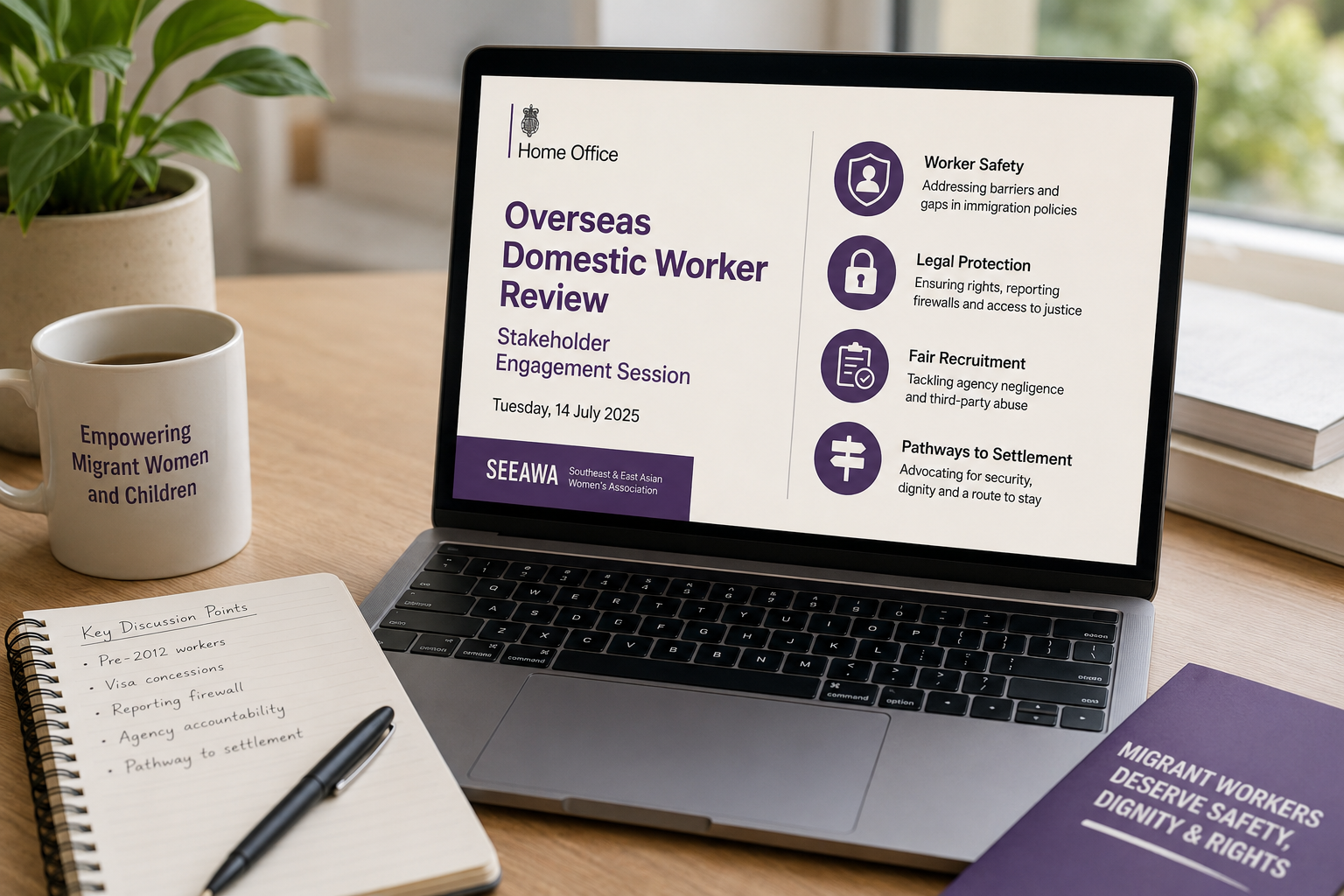
On Tuesday, 14th July, SEEAWA representatives attended the Home Office’s online engagement session for the Overseas Domestic Worker Review. The meeting brought together key stakeholders from migrant charities, domestic worker associations, and trade unions to discuss critical gaps in current immigration policies and identify the primary barriers to worker safety.
Overcoming Barriers to Settlement
A central focus of the session was addressing the ongoing challenges faced by domestic workers who entered the UK prior to 2012. Many in this cohort have been left unable to secure formal settlement, leaving them in a state of long-term immigration insecurity. Attendees highlighted the systemic barriers preventing these individuals from regularising their status, emphasizing that legal precarity severely increases a worker’s vulnerability to exploitation.
Key Policy Priorities Raised by Advocates
During the consultation, SEEAWA and fellow advocacy groups put forward specific, urgent recommendations to protect workers from modern slavery and institutional abuse:
- Reinstating Pre-2012 Protections: Attendees argued that a complete return to the pre-2012 ODW visa concession is the single most effective structural change required. Restoring the original visa conditions would allow workers the right to renew their visas annually and change employers freely, providing a practical route to escape abusive conditions.
- Implementing a Clear Reporting Firewall: Advocates stressed the immediate need for a strict data-sharing firewall between the police, the NHS, and Immigration Enforcement. Without the guarantee that reporting abuse will not lead to detention or deportation, victims remain forced to suffer in silence.
Addressing Third-Party Negligence and Agency Abuse
The discussion also exposed the severe challenges workers face from unregulated or negligent recruitment practices. Attendees shared troubling evidence showing that exploitation does not always originate solely from the immediate employer; it is frequently enabled by recruitment agencies.
Stakeholders highlighted cases where agencies noticed profound contractual discrepancies but failed to support the worker. In some instances, agencies permitted domestic workers to sign contracts under entirely different names—such as using the name of an abusive employer’s relative—to bypass existing Home Office bans on known abusers. Participants urged the review to account for this institutional negligence, noting that enabling hidden employment structures constitutes a direct form of systemic abuse.
The Scope of the Review and Next Steps
While we were grateful for the chance to share these thoughts directly with civil servants, it is important to note the limitations of the session’s scope. The Home Office’s agenda was strictly focused on supporting pre-2012 domestic workers and identifying their specific barriers to settlement.
Broader systemic changes—such as implementing an NHS or police reporting firewall, or completely reversing the ODW visa concession rules—are political decisions outside the direct control or focus of the Home Office staff conducting this operational review. Realizing these protections requires political will and legislative changes from elected politicians.
Because these wider protections are decided by lawmakers, we strongly encourage our community members and supporters to write to their local MPs. Raising these urgent issues with your MP is a vital step in pressuring politicians to close the legal loopholes that leave domestic workers vulnerable to abuse and modern slavery.
The Home Office is accepting additional evidence and written contributions regarding the Overseas Domestic Worker Review until 28th July.